Multiple Traditions &
12 Years a Slave
PS140O: Projecting Power
2025-02-04
Housekeeping
Everyone is assigned a Video Essay group
For Section, just read 198-201 of Smooha
Quizzes
Quizzes
– Week 3, Tues 2/4
– Week 5, Tues 2/18
– Week 7, Tues 3/4
– Week 9, Tues 3/18
– Week 11, Tues 4/8
– Update Week 13, Tues 4/22
How should we think about slurs, violence, etc?
- What is the intent?
- Is the use gratuitous?
- What is the context?
- It’s okay to be upset sometimes
- Let’s talk
King & Smith
What is a social order?
- Formal and informal institutions that structure society
- Who is allowed to do what?
- Formal
- Laws, courts, police, military
- Religious and educational institutions
- Informal
- Norms, codes of conduct, status hierarchies
- Rules of the game
Can we measure informal norms?

What is a “racial institutional order”?
- “American politics has historically been constituted in part by two evolving orders”
- “White supremacist” order
- “Transformative egalitarian” order
- Cross-nationally, perhaps
- Ethno-nationalist order
- Egalitarian order
K&S: Political Institutional Orders
- “We see all political institutional orders as coalitions of state institutions and other political actors and organizations that seek to secure and exercise governing power in demographically, economically, and ideologically structured contexts that define the range of opportunities open to political actors.”
K&S: Political Institutional Orders
- “We see all political institutional orders as coalitions of state institutions and other political actors and organizations that seek to secure and exercise governing power in demographically, economically, and ideologically structured contexts that define the range of opportunities open to political actors.”
What are “racial projects”?
“By presenting racial orders as political coalitions, we build on Omi and Winant’s (1994) depiction of ‘racial formation’ as a product of many elite-led ‘racial projects’ (53–76)…”
“Like many other scholars of American political development, we treat political entrepreneurs and the preexisting institutional orders in which they operate as the key independent variables shaping all political change, including racial development.”
How durable are “racial orders”?
- “The balance of power in those interactions has shifted over time in part because, like most politically constructed coalitions, America’s racial orders have been complex and breakable. Most political actors possess partly conflicting identities and interests, and there are always many goals they might like to pursue.”
What about important complexities?
- “Despite these complexities… Scholars can recognize that issues such as slavery, Jim Crow segregation, and racially targeted aid programs have at different times been the central disputes around which political battle lines have formed. Hence in each era scholars can identify empirically the main institutions and actors allied to sustain the then-dominant forms of white supremacy, thereby comprising that period’s ‘white supremacist’ order, and the leading institutions and actors working for more egalitarian racial conditions, its ‘transformative egalitarian’ order.”
Not only Black and White
- “Both evidence and parsimony lead us to posit two potent, evolving racial systems at work: first, the set of “white supremacist orders” created to defend slavery and also the displacement of the tribes. Even the Declaration of Independence sought to justify tribal subjugation (by denouncing ‘merciless Indian Savages’) and to avoid criticism of chattel slavery (by excising Jefferson’s language attacking the slave trade).”
Made racial identities seem natural
- “This white supremacist order made explicitly racial identities seem natural and vital to millions. It habituated many it privileged as ‘white’ to think of their racial status as a primary feature of their lives (Du Bois 1992, 700–01). Its imposed inequalities gave many white farmers and workers as well as slaveholders a sense of economic dependency on the maintenance of racial restrictions that seemed to make their lands, jobs, and wages more secure. It also generated in many a sense of racial entitlement, which most defended in religious and biological terms.”
Multiple Traditions
- “Yet U.S. history displays a rival, expanding ‘transformative egalitarian racial order’ that built on doctrines and institutions of equal rights also present from the nation’s inception. The American revolutionaries rejected monarchy and aristocracy for democratic republics, and systems of primogeniture and entail for greater individual powers over property. Then they created many new political, economic, and cultural institutions to pursue the broad goals of ‘equal rights’ and ‘equality before the law,’ and that provided greater equality to European-descended men than ever before.”
Egalitarian order rules during Reconstruction
- “After the fifteenth Amendment in 1870, the expanded egalitarian order centered on new constitutional guarantees of formal racial equality in political as well as economic and civil rights. Its propo- nents included many congressional Republicans, new Reconstruction agencies like the Freedmen’s Bureau and the Freedmen’s Saving Bank, many Republican state officials including black officeholders, religious reform groups, and the numerous new black schools and civil groups they helped create.”
Discuss: Where do we see the egalitarian tradition in 12 Years a Slave?
Let’s hear from: Crystal, Michelle, Patrick, Kayla
Racial orders keep swapping power
- Yet just as the Civil War egalitarians did not succeed in removing all institutional bases for the resurgence of the white supremacists, so their new system did not eradicate the postwar egalitarian racial order. The constitutional provisions and some national and state statutes remained available for judges willing to apply them. Often dissenters and sometimes even majorities did so, as when the Supreme Court upheld birthright citizenship for Chinese Americans and struck down laws that overtly banned blacks from juries and prevented whites from selling housing to blacks (U.S. v. Wong Kim Ark, 169 U.S. 649 [1898]; Rogers v. Alabama, 192 U.S. 226 [1904]; Buchanan v. Warley, 245 U.S. 60 [1919]).
Does this apply to the present?
- “We hope it is clear at this point that, just as a racial orders framework helps explain much about America’s past, many key features of what analysts have deemed today’s ‘postsegregation era’ (Reed 1999) or period of ‘advanced marginalization’ of African Americans (Cohen 1999) can be illuminated by viewing them as clashes between the modern, internally conflicted ‘transformative egalitarian’ racial order and the resurgent ‘antitransformative’ racial order.”
Discuss: How else does King & Smith’s framework help illuminate 12 Years a Slave?
Let’s hear from: Liz, Nicholas, Fabian, Bailey
Video Essay: Sami Blood
Worgs: “Beware of the Frustrated…”
“As American as Apple Pie”
Violence is central to founding of America
African Americans have engaged in an ongoing struggle for liberation—from slavery, discrimination, and the various manifestations of racial oppression
In this struggle for liberation, African Americans have often used violence as a tactic or strategy
Worgs “examines the phenomenon of fantasies about violent revolt to expand the understanding of why such incidences occur”
Four Themes of Violent Revolt
Violent revolt is understood by many as both instrumental (a means to a desired end—usually freedom) and cathartic
Themes:
- a justification of violence
- need to fight to gain the “respect” of the oppressor
- the rage of the oppressed as well as yearning for retribution
- the humanizing or transformative effect of participating in a violent revolt against an oppressor. Move from object to subject
History of Violent Revolt
Evidence of hundreds of incidents where enslaved Africans engaged in or plotted to engage in violent uprisings
Including “plots of Gabriel Prosser in 1800 and Denmark Vesey in 1822, as well as extensive violent clashes such as Stono Rebellion of 1739 or Nat Turner–led uprising in 1831”
Enslaved Africans seizing control of slave ships
Under Jim Crow, African Americans often took up arms to defend themselves, friends, elected officials, schools, churches
“Most familiar form of Black violent revolt is the mass riot”
Theme 1: Justification of Violence
Concept of self-defense as the primary justification
Douglass (1853/1993), for example, locates the slave revolt within the “American” tradition of using violence to obtain freedom as he equates the violence of the slave revolt with that of the American Revolution
Robert F Williams in 1960s argued Blacks were in a circumstance in which the law offered no protection against White attacks. As such, they had to defend themselves
Theme 2: Respect
Martin Delaney’s (1859/1993) work best expresses the notion that the oppressed must fight to gain the respect of the oppressor.
An Indian chief tells the story’s hero, Blake, who escaped slavery and commenced to organize insurrections throughout the South and Cuba, that “If you want white man to love you, you must fight ‘im!’”
“The quest for respect is not a desire for sensitivity or inclusion. It is a yearning for a respect for Black life, for Black humanity”
Theme 3: Rage and Retribution
Communicate anger
In William Wells Brown’s work (1864/1993) the character Glen, an enslaved African who uses violence to seize his freedom, tells of the “volcano pent up in the hearts of the slaves of these Southern states that will burst forth ere long. When that day comes, woe to those whom its unpitying fury may devour!”
Theme 4: Humanizing Power
Idea that violent action in response to oppression can have a humanizing power
“When the oppressed strike a blow for freedom, they in a sense seize back their humanity.”
Jean Paul Sartre and Frantz Fanon tell us that the violence of the oppressed against the oppressors is “man recreating himself” (Sartre, 1963).
Fanon (1963) argues oppressed find “freedom in and through violence,” it is “a cleansing force”
“They move from object to subject.”
Discussion:
What are examples of violent revolt (real or imagined) in 12 Years a Slave?
Let’s hear from: Rithika, Alisa, Yana, Katie
Questions?
Quiz
Break
Video Essay: 12 Years a Slave
Schematic Overview of SDT

Social Domiance, Figure 2.1
Institutional-level SDT

Social Domiance, Figure 2.1
One Institutional Dynamic: Systematic Terror
Use of violence or threats of violence disproportionately directed against subordinates
Systematic terror functions to maintain expropriative relationships between dominants (ie, members of dominant groups) and subordinates (ie, members of subordinate groups)
Enforces the continued deference of subordinates toward dominants
Three Types of Systematic Terror
Official terror is the public and legally sanctioned violence and threat of violence perpetrated by the state
Semiofficial terror is the violence or intimidation directed against subordinates, carried out by officials of the state (eg, internal security forces, police, secret police, paramilitary organizations) but not publicly, overtly, officially, or legally sanctioned by the state
Unofficial terror is that violence or threat of violence perpetrated by private individuals from dominant groups against members of subordinate groups
Law and Order
With SDT, law is understood to be written and enforced so as to favor the interests of dominants
Order is often defined as those social conditions that disproportionately protect and maintain the interests of dominants
Many assume discrimination within criminal justice system is relatively rare and nonsystematic
SDT suggests that discrimination within the criminal justice system is quite systematic and comprehensive in its effects
“For my friends, anything; for my enemies, the law.”
— Oscar R. Benavides, President of Peru (1933-1939)
Behavioral Asymmetry
There will be differences in the behavioral repertoires of individuals belonging to groups at different levels of the social power continuum
Behavioral asymmetry will also be affected by socialization patterns, stereotypes, legitimizing ideologies, psychological biases, and the operation of systematic terror
Ideological-level SDT

Social Domiance, Figure 2.1
Legitimizing Myths
Two functional types: Hierarchy Enhancing (HE) and Hierarchy Attenuating (HA)
Hierarchy Enhancing Legitimizing Myths (HE-LMs)
“What all these ideas and doctrines have in common is the notion that each individual occupies that position along the social status continuum that he or she has earned and therefore deserves. From these perspectives then, particular configurations of the hierarchical social system are fair, legitimate, natural, and perhaps even inevitable.”
Legitimizing Myths
Hierarchy Attenuating Legitimizing Myths (HA-LMs)
HE-LMs serve to exacerbate and maintain group-based social inequality
HA-LMs serve to promote greater levels of group-based social egalitarianism
Discussion:
What are examples of legitimizing myths in 12 Years a Slave?
Let’s hear from: Kierstyn, Amy, Luci, Nadia
Individual-level SDT

Social Domiance, Figure 2.1
Social Dominance Orientation (SDO)
- SDO is defined as the degree to which individuals desire and support group-based hierarchy and the domination of “inferior” groups by “superior” groups
SDO Scale
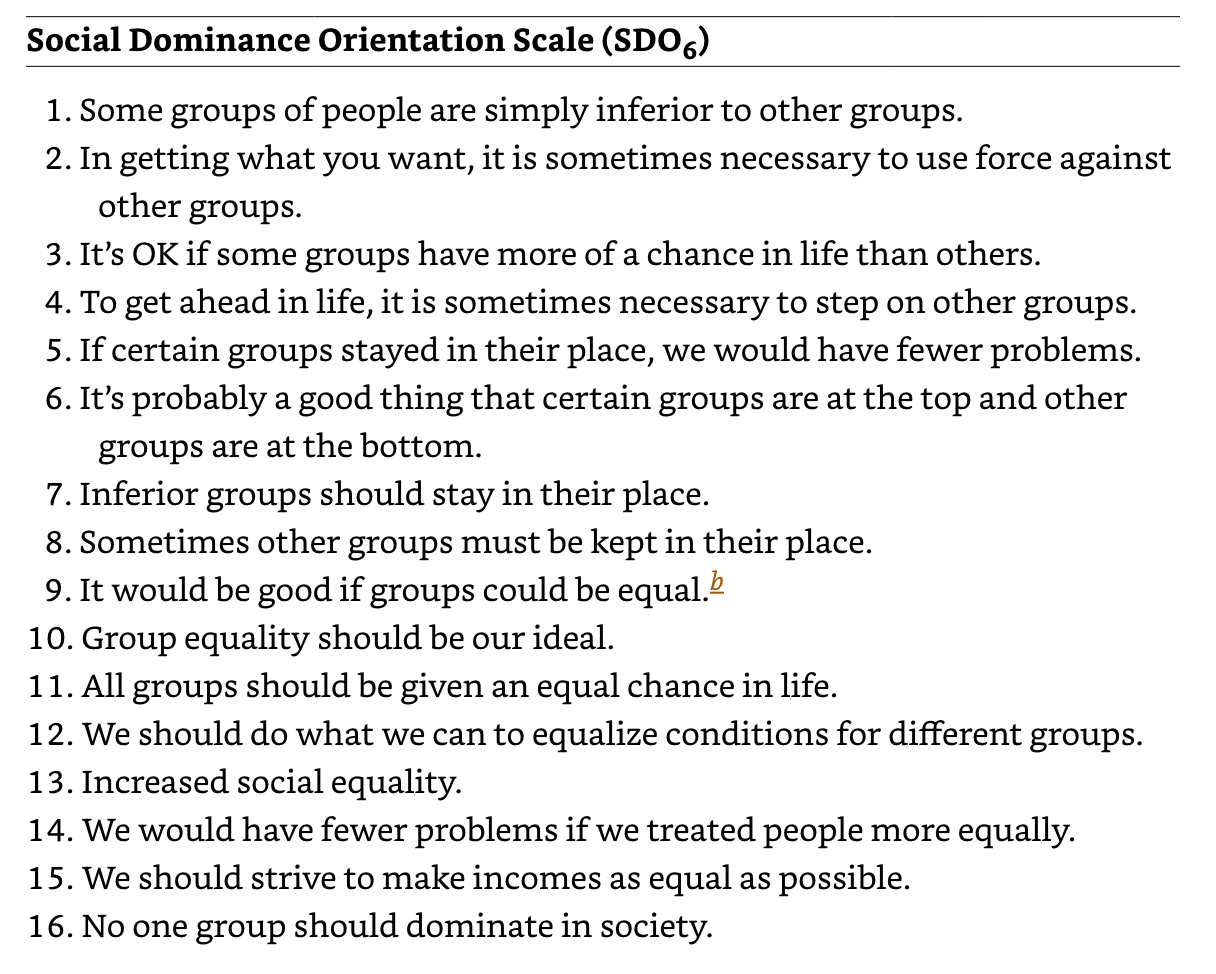
Items 9-16 reverse coded. Response scale was 1 = very negative to 7 = very positive.
Social Organization with Primates
All primates within hominoid clade (ie, chimpanzees, bonobos, gorillas, and baboons) have systems of social dominance
Further, there is a group-based nature to these systems
Trimorphic structure similar to humans with social status a function of:
- age (older animals dominating younger animals)
- sex (males dominating females, with major exception)
- position in kinship and friendship groups, eg, rudimentary arbitrary-set systems
What are some Key Compositional Choices?
- Pace
- Diegetic vs non-diegetic sound
- Characters
- Overseer, children, woman with water, wife
- Acts of resistance, acts of acceptance
Diegetic vs non-diegetic
- Diegetic: Sound whose source is visible on the screen or whose source is implied to be present by the action of the film such as
- voices of characters
- sounds made by objects in the story
- music represented as coming from instruments in the story
Diegetic vs non-diegetic
- Non-diegetic: Sound whose source is neither visible on the screen nor has been implied to be present in the action:
- narrator’s commentary
- sound effects which is added for the dramatic effect
- mood music
Discuss: Why shift to diegetic sound?
Let’s hear from: Gretchen, Yuning, Madeleine, Praceda
Social Dominance